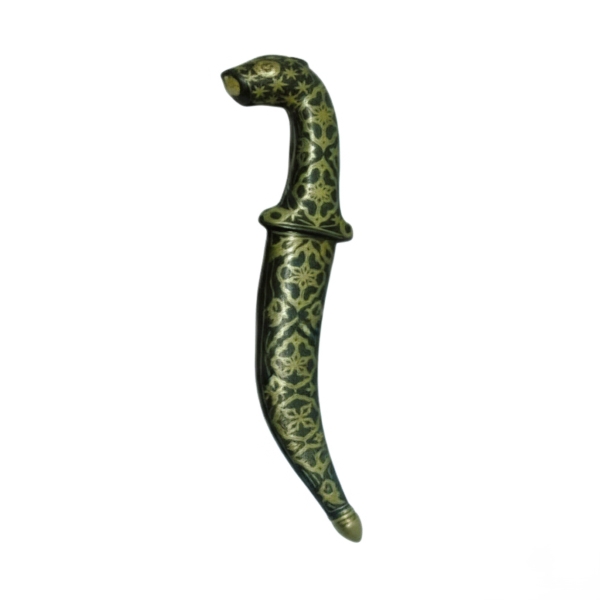
Calligraphy Dagger
Code : P13974
INR
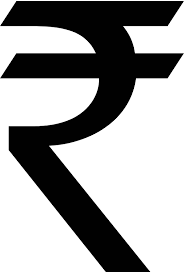 9000 /
 Piece MRP : 13650 34% Off Excluding Taxes & Duties
Extra Charges : Shipping | Insurance | Packaging
Net Weight : 0.750 Kg
Description :
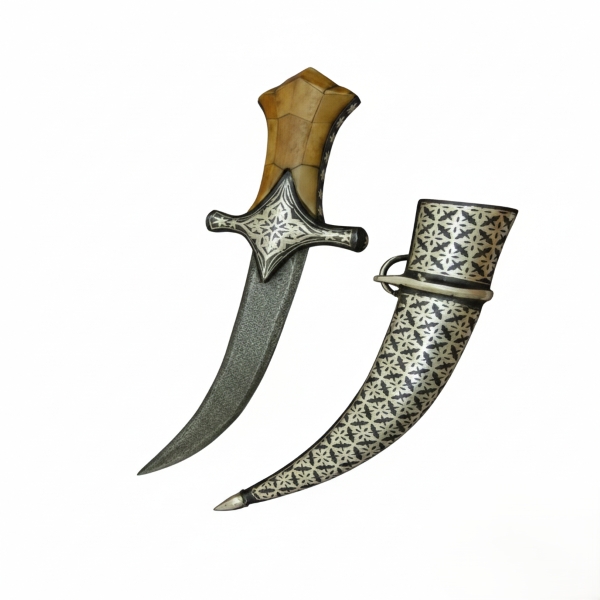
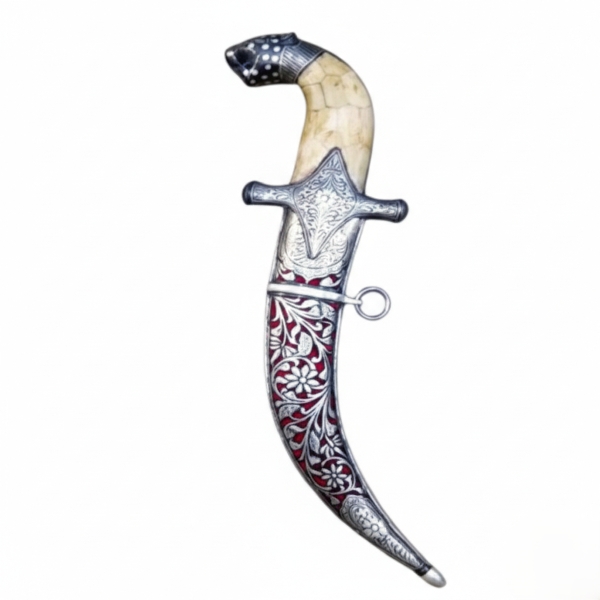
Calligraphy daggers are ornate, historically significant weapons from India, Persia, and the Ottoman Empire, featuring blades or hilts adorned with deeply engraved Arabic, Persian, or Turkish calligraphy, often invoking religious verses, prayers, or royal inscriptions. These 16th-19th century items, such as the katar or kard, typically feature high-quality steel, gold damascening, gem-set handles, and artistic, flowing script, blending elite functionality with luxury. These daggers represent a blend of martial utility and high artistic expression, particularly in Islamic and Mughal-influenced art, often serving as both functional armour-piercing tools and decorative items. Location : Rajasthan, India
Specification :
| Length |
: |
12 inches | | Country Of Origin |
: |
Region: Primarily manufactured in the narrow artisan lanes of Udaipur and Jaipur, Rajasthan.
Legacy: Produced by master Sikligars who specialize in Shabash (praise) weaponry—pieces designed more for their beauty and meaning than for the battlefield. | | Specialty |
: |
Script Focus: The dagger is designed with a wider flat on the blade specifically to provide more surface area for calligraphic inscriptions.
Gold-Leafing: Often utilizes the Teh-Nishan technique, where gold or silver is deeply hammered into the steel to ensure the calligraphy never fades. | | Uses |
: |
Heirloom Gifting: Frequently commissioned for weddings or major life achievements to carry a written blessing for the recipient.
Spiritual Display: Placed in home offices or libraries to symbolize the union of Gyan (Knowledge) and Shakti (Power).
Executive Utility: Functions as a premium, heavy-duty letter opener for luxury desk sets. | | Theme |
: |
The Power of Truth: Most designs centre around the theme that The Word is sharper than the Blade.
Indo-Persian Poetry: Common themes include the Rubaiyat style of quatrains or traditional Rajputana bravery couplets. | | Weight |
: |
Total Weight: Typically ranges from 300g to 550g.
Feel: Light and nimble; the weight is distributed to allow for easy rotation of the dagger to read the text along the blade. | | Blade Material |
: |
Mirror-Finished Steel: High-carbon steel is polished to a water-like shine so that the etched calligraphy reflects clearly.
Damascus Steel: Often used for high-end versions, where the natural flow of the steel patterns complements the fluid lines of the script. | | Handle Material |
: |
Contrasting Bone: Uses Polished Camel Bone to provide a stark white contrast against the dark or polished steel blade.
Engraved Hilt: The bone is often left smooth to emphasize the natural grain, or lightly etched with geometric borders that frame the blades calligraphy. | | Artisanal Characteristics |
: |
Chiselled Script: The calligraphy is hand-chiselled rather than machine-engraved, giving each letter a unique, organic depth.
Brass/Silver Accents: The bolsters (the metal part between the handle and blade) are usually heavily engraved to match the script style.
Signature Sheath: A wooden scabbard wrapped in Deep Crimson or Emerald Green velvet, often featuring a belt-loop made of braided silk thread. | | Cultural And Traditional Heritage |
: |
The Courtly Tradition: In the royal courts of Rajasthan, a man was judged by his Kalam (Pen) and his Khadga (Sword). This dagger is the ultimate tribute to that dual identity.
Spiritual Protection: It is a common Rajasthani tradition to have daggers inscribed with protective verses, believing that the physical Word of God on steel acts as a permanent shield for the household. |
About Seller :
The Seller is located from "Rajasthan, INDIA " and specialized in HANDICRAFT.
|

.jpg)
.jpg)
.jpg)
.jpg)
.jpg)